Jump to section
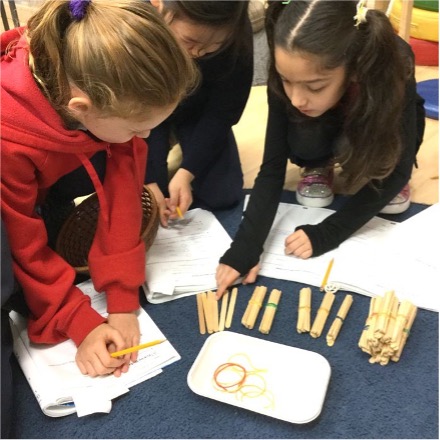
- Reception 1 Overview of Big Ideas
- Reception 2 Critical Areas of Focus
- Reception 2 Common Core State Standards
- Grade 1 Critical Areas of Focus
- Grade 1 Common Core State Standards
- Grade 2 Critical Areas of Focus
- Grade 2 Common Core State Standards
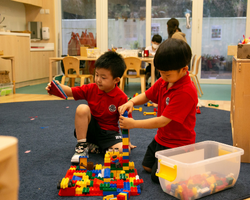
Reception 1 Overview of Big Ideas
Describe how objects are the same and different:
The big idea of “same and different” is explored throughout the year with familiar small parts such as toys, crayons and buttons. Students will identify attributes, match, sort, compare and order a variety of objects in everyday contexts.
Demonstrate knowledge of patterns:
Patterning is an extension of the big idea “same and different”. Here, children investigate and describe order in their world both qualitatively and quantitatively by identifying, replicating and extending patterns.
Explore and describe spatial relationships and shapes:
Children learn the language of location to describe the relative position of themselves and objects in space. Children also explore 3-dimensionaleveryday objects (real-world) before being introduced to 2-dimensional objects.
Use number concepts:
- Conservation:
The big idea of conservation is an important foundational concept for number and capacity. For example, children have many opportunities to describe that moving objects around has no effect on the total number of objects. - Counting:
Children progress from rote counting through one to one correspondence to keeping track of the number of objects counted. - Unitizing:
Students will explore how a number can be represented as a group or broken up into individual parts. - Operations:
Students will build their understanding of the meaning of the operations through stories that children can illustrate, act out or demonstrate with objects.
Reception 2 Critical Areas of Focus
Representing, relating, and operating on whole numbers, initially with sets of objects
Describing shapes and space
More learning time in Kindergarten is devoted to number than to other topics
Reception 2 Common Core State Standards
Counting and Cardinality:
- Know number names and the count sequence
- Count to tell the number of objects
- Compare numbers
Operations and Algebraic Thinking:
- Understand addition as putting together and adding to, and understand subtraction as taking apart and taking from
Number and Operations in Base Ten:
- Work with numbers 11-19 to build foundations for place value
Measurement and Data:
- Describe and compare measurable attributes
- Classify objects and count the number of objects in categories
Geometry:
- Identify and describe shapes
- Analyze, compare, create and compose shapes
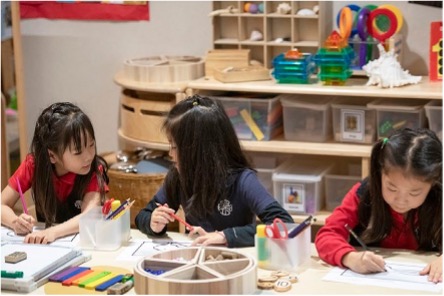
Grade 1 Critical Areas of Focus
Developing understanding of addition, subtraction, and strategies for addition and subtraction within 20
Developing understanding of whole number relationships and place value, including grouping in tens and ones
Developing understanding of linear measurement and measuring lengths as iterating length units
Reasoning about attributes of, and composing and decomposing geometric shapes.
Grade 1 Common Core State Standards
Operations and Algebraic Thinking:
- Represent and solve problems involving addition and subtraction
- Understand and apply properties of operations and the relationship between addition and subtraction
- Work with addition and subtraction equations
Number and Operations in Base Ten:
- Extend the counting sequence
- Understand place value
- Use place value understanding and properties of operations to add and subtract
Measurement and Data:
- Measure and compare a variety of lengths with non-standard units
- Tell and write time
- Represent and interpret data
Geometry:
- Reason with shapes and their attributes
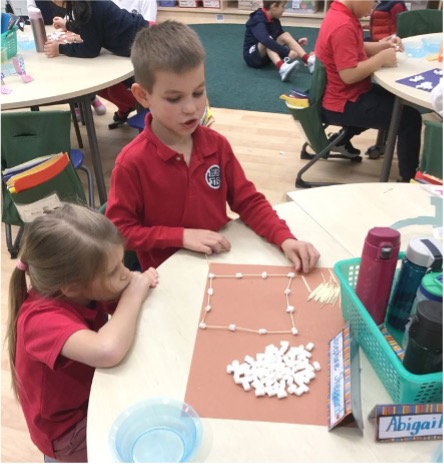
Grade 2 Critical Areas of Focus
Extending understanding of base-ten notation
Building fluency with addition and subtraction
Using standard units of measure
Describing and analyzing shapes
Grade 2 Common Core State Standards
Operations and Algebraic Thinking:
- Represent and solve problems involving addition and subtraction
- Work with equal groups of objects to gain foundations for multiplication
Number and Operations in Base Ten:
- Understand place value
- Use place value understanding and properties of operations to add and subtract
Measurement and Data:
- Measure and estimate lengths in standard units
- Relate addition and subtraction to length
- Work with time and money
- Represent and interpret data
Geometry:
- Reason with shapes and their attributes