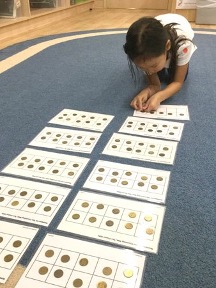
In Lower Primary, the Standards for Mathematical Practice from the Common Core State Standards guide our teaching and learning in mathematics. While the Five Strands of Mathematical Proficiency describe what it means to be mathematically successful, the Mathematical Practices describe how students think and work to develop that proficiency. These practices reflect the habits and approaches of productive mathematical thinkers and are intentionally embedded in daily instruction. Through exploration and investigation, we support children in communicating their ideas, representing their thinking, and reflecting on their mathematical experiences.
Standards for Mathematical Practice
Common Core State Standards for Mathematical Practices | Student-Friendly Language |
Make sense of problems and persevere in solving them. | “I can make sense of problems and not give up.” |
Reason abstractly and quantitatively. | “I can think about and show numbers in different ways.” |
Construct viable arguments and critique the reasoning of others. | “I can explain my thinking and try to understand others.” |
Model with mathematics. | “I can model problems in many ways.” |
Use appropriate tools strategically. | “I can choose and use math tools. “ |
Attend to precision. | “I can work carefully and check my work.” |
Look for and make use of structure. | “I can find patterns and number relationships.“ |
Look for and express regularity in repeated reasoning. | “I can use patterns and take shortcuts.” |