Jump to section
- Literacy (Listening, Speaking, Reading, and Writing)
- Reception 1 Literacy Components:
- Reception 2, Grade 1 and Grade 2 Literacy Standards
- Mathematics
- Religious Education
- Standard 1:
- Standard 2:
- Standard 3:
- Social Studies and Science
- Design and Technology
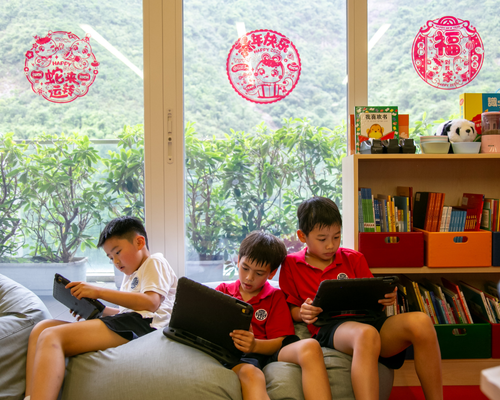
In Lower Primary, we believe in children’s capacity and agency to construct meaning. Inquiry, through a language-rich environment, play and collaborative projects, is the most motivational and purposeful way for students to learn. Through a child-centered approach to teaching and learning, teachers design a developmentally appropriate curriculum where children’s interests are reflected. We believe in making learning visible by documenting and reflecting process, not product, thus assessing student learning authentically.
Literacy (Listening, Speaking, Reading, and Writing)
The Lower Primary School uses curriculum that is founded on standards by the National Association for the Education of Young Children (NAEYC) and the Common Core State Standards. Reception 1 uses components identified by the Creative Curriculum for Preschool in conjunction with the NAEYC. Reception 2 through Grade 2 uses the Common Core State Standards as foundations to the curriculum.
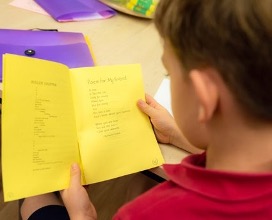
Reception 1 Literacy Components:
- Building a reader and writer identity
- Speaking and listening
- Literacy as a source of enjoyment
- Vocabulary and language
- Phonological awareness
- Letters and words
- Comprehension
- Books and other texts
Reception 2, Grade 1 and Grade 2 Literacy Standards
- Literacy Foundational Skills: phonemic awareness, phonics/decoding, spelling, conventions
- Comprehension and Analysis: Reading and listening to various types of text (narrative, opinion, and informational texts) and analyzing language meaning
- Composition and Communication: Writing and using various forms of language related to narrative, opinion, and informational texts
Mathematics
At HKIS, the Common Core State Standards for Mathematics and the Standards for Mathematical Practice together form the foundation of our mathematics program. The content standards provide a clear, focused progression of skills and concepts, building coherently from one grade to the next and connecting new learning to prior knowledge.
Rather than covering many topics superficially, our curriculum prioritizes depth over breadth. Children develop strong conceptual understanding through play, inquiry, and hands-on exploration, using a variety of tools, models, and strategies to make sense of mathematics. Learning is active and purposeful, with children given time to investigate, wonder, and discover.
The Standards for Mathematical Practice describe the habits of mind of productive mathematical thinkers: reasoning and explaining, modeling and using tools, and seeing structure and generalizing. These practices shape how we teach and how children learn. We support children in communicating and justifying their thinking in multiple ways, helping them develop both confidence and deep understanding.
In Lower Primary, our goal is to help every child grow as a confident and capable mathematician.
Concrete (Build it) → Pictorial (Draw it) → Symbols (Represent it)
This progression guides students’ understanding of mathematical concepts.
Religious Education
At HKIS, Religious Education reflects the school mission and SLRs. As a school "grounded in the Christian faith and respecting the spiritual lives of all", we provide students an academic study of religion. Religion units in the Lower Primary explore a variety of topics and ideas. Each topic is explored from a Christian perspective. Students then explore how people of other faiths view that same topic, which helps them understand how others see the world. In LP we are focused on similarities of believers. We support our students in their individual spiritual journey.
HKIS has developed a unique set of standards to closely encompass our core beliefs. Our Religious Education program is developed around three standards. As students learn about Christianity and other world religions, the development of individual spirituality is the thread that ties everything together.
Standard 1:
Students recognize, define, and articulate their own spiritual identity, and demonstrate how it applies to their personal decisions.
Standard 2:
Students demonstrate an understanding of the Christian story and the centrality of Jesus in the Bible.
Standard 3:
Students understand both the common and unique beliefs, practices, and influence of the major religions of the world.
Grade levels hold monthly chapels focused on the Christian message, as well as assemblies focused on many themes including special visitors and cultural festivals. Divisional chapels take place once a month. (Students also gather as a community for Christmas and Easter assemblies.)
Social Studies and Science
Science and social studies are taught using an inquiry-based approach. In science, children engage in the scientific processes including observation, collecting, recording and interpreting data, predicting, classifying and drawing conclusions are practiced in hands-on, meaningful activities. In social studies, students study civics and citizenship while being active participants in their own classroom communities, exploring how communities are organized. Overall, students learn concepts, as well as information. In addition, skills of reasoning, problem solving, working collaboratively, goal setting and decision making are practiced throughout the curriculum.
Design and Technology
In Lower Primary, we believe children learn best through hands-on experiences where they explore, create, and build their own understanding. Through purposeful use of technology and opportunities to design and make, students develop creativity, problem-solving skills, collaboration, and confidence.
The Design and Technology Coach partners with the Teacher Librarian and classroom teachers to support learning across the curriculum. Together, they guide students in using age-appropriate physical and digital tools to explore ideas, document their thinking, and share their learning in meaningful ways. In practice, this may include building structures, programming simple robots, creating digital stories, or capturing learning through photos and reflections.
Our dedicated makerspace, the Wonder Lab, is designed for young learners to explore, build, and discover. Inspired by the Reggio Emilia philosophy and children’s natural curiosity, the Wonder Lab is a space where students engage in playful inquiry and creative problem-solving. Students are encouraged to explore their own ideas, take risks, and learn through iteration.
Technology is used intentionally to support creativity, communication, and learning. Through guided experiences, students also develop foundational digital citizenship skills, learning to be safe, kind, and responsible when using technology in a connected world.